Followers

Facebook Badge

Athena Smith's Facebook profile

Sunday, November 2

Where there's smoke there's fire.


Pasco County looks at changing hiring
polices that would effectively ban hiring people
who smoke in attempts to create a smoke free
work force.


The Suncoast Pasco News ran an article stating the following: Dade City, among others is looking into the idea of banning the hiring of those who smoke cigarettes and creating a program for those who are currently on their payroll to kick the habit.

This has been presented as an attempt to lower their health insurance cost which it certainly will accomplish. It will also clean up the county vehicles; anyone who does not smoke and who has gotten into a vehicle of a smoker knows what I am talking about. But there are other benefits as well including less missed time due to health reasons. The article went on to say smokers use medical insurance benefits 50% more often than non-smokers.

Two sheriff offices in Pasco and Pinellas counties have already implemented such bans and seem to have been successful. Many other places of employment are looking at ways to reduce their health insurance cost as well. Given the state of the economy, more and more companies and governmental employers are looking at ways to reduce costs and one can not blame them.

There may be, however, an underlying problem with this type of policy. The EEOC states that an employer can not discriminate on the basis of sex, race, gender, religious belief, sexual orientation, creed, disability, age, appearance, etc. etc. but cigarette smoking is not listed. However, neither is the consumption of alcohol. Though many companies can and do drug test their employees or potential employees and utilize the information gained as criteria for employment, cigarettes and alcohol are not included. They are only testing for drugs and we must remember that drugs are illegal. Although testing of cigarette usage is very new, it seems to be on the rise and one of the latest attempt to save a dollar, yet it remains a legal substance.

If the goal is saving money, why stop at cigarette smokers. Why not include those who consume alcohol. I think everyone can agree that those who drink are more apt to miss work from a hangover than those who don’t. They are more likely to develop liver problems. Not to mention, if they happen to be driving a company vehicle and have a drink. You would not run that risk with someone who never drinks alcohol. And then there those that are overweight. Recent information has suggested that people who are morbidly obese are actually at a higher risk of health problems than those who smoke. Should employers have the right to demand that people lose weight? Remember this is about saving money, but at what cost.


Currently it is legal to drink and smoke cigarettes and there are those who over indulge when it comes to food. However, it would seem that in the name of saving a few dollars, people may have to change their lives in order to retain employment. While this seems like a win-win, I am not so sure it is.

Some time ago, perhaps twenty to thirty years, the anit-smoking movement began and now we all can safely belittle and look down at smokers. I think that’s fine but what happens when it becomes one of your vices. What if an anti-alcohol movement comes along. You may be forced into a position of having to gives up one of your vices so that you may retain your job or be eligible for employment. It may seem that your particular vice is safe but think again. Less than thirty years ago, cigarette smoking was the in thing.
Today one is ostracized for such behavior. Will alcohol be next?

Should employers be allowed to utilize smoking as criteria for employment? Furthermore, would you be okay with employers or potential employers utilizing alcohol as a criteria for employment and using the same argument? How far into our personal lives should employers be allowed to delve?

Sunday, October 26

Thoughts on the status of the black male


The following posting was based on the article "The black man... an endangered species" by Tiffany Chiles, published in DONDIVA, 2008.

There are so many areas that we, the black men are referred to as “unknown.” Society has been discounting the black man for hundreds of years and he has literally become unknown. We’ve lost a generation of black males to the streets, gangs, drugs, unemployment, violence, crime and broken homes. The question that we need to ask ourselves is will we allow the next generation to be lost or taken from us as well.

A quarter of black Americans live below the federal poverty level, a rate about twice the national rate. More than a third of all black children live in poverty, and almost two thirds grow up in homes without both parents. In some cities, more than half of all black boys do not finish high school, and by the time they are in their 30’s almost 6 in10 black high school drop outs will have spent time in prison. Half of all black men in their 20’s are jobless. The typical black household earns only about 60% of the earning of white households and has a net worth only about 10% of that of whites. The HIV/AIDS rate is highest for black Americans and blacks are more often the victims of inadequate healthcare. In 2008 the government has been enforcing drug laws that put young poor black men and women at a higher risk of incarceration. Two generations ago, you could go through a phase, get in trouble with the law, get involved with drugs for a minute, hustle a little dope until something happened to scare you straight. Today, you no longer have the opportunity to learn from your mistakes or be scared straight. Due to harsh Federal and State drug laws you mess up the first time and it could men a lengthy prison sentence. And that one prison sentence could affect the rest of your life and the rest of your family. You are the unknown. You can’t vote, you can’t get a job, you can’t get a grant or financial aid for school, you can’t live in public housing (not even with your momma), and you can’t get health care. You can’t support yourself or your family. The only thing you can do is exactly what the system knows you will do, commit more crimes to survive. This is why the recidivism rate amongst blacks is so high. For first time offenders, the rate of re-incarceration can be as high as 15%, for individuals with prior criminal history it can be almost 40%. These individuals don’t want to commit any crimes and be at risk of going back to jail but they feel they have no choice, it’s do what you do best or starve. The choice thereafter becomes instinctive. They are trying to survive in a society that wants to keep them unknown.

While we do believe that people in prison are a danger in society, there is something gravely wrong when there is a 2.2 million people in jail and almost 1 million of them are black, when the fact is that black people make up only 13 percent of societies makeup on a whole. If you as a parent have been incarcerated, your children are 6 times more likely to go to jail because you did. Most minorities know someone who knows someone that is in jail, that’s been to jail, or that’s been to jail themselves. Conversations about inmates in prison seem normal to us. Prison in the black community has lost its negative stigma. In 2007 the Bureau of Justice reported that the leading cause of death among black males ages 16 to 34 was black on black homicide. Today’s youth are disrespectful and wreckless as many participate in criminal activities for some feeling of acceptance and family. It is probable that their fathers aren’t in the home because he has either purposely disappeared, been violently killed or incarcerated. In 2008 it’s a sad truth but one in three is likely.

The black man is disappearing from existence in record numbers. They are being lost to poverty, HIV, violence, death, and incarceration. We cannot continue to treat these problems like many of us do our personal problems- we ignore them. We have already lost our fathers, brothers and men, we don’t want our children to be lost as well.

How do you perceive the black man of today? What can be done to bridge the gap between the races?

Sunday, October 19

Cutting funds from FARC budget


(Note: Child in this article is a term meaning to range from kids to adults)


In 2007 state legislators voted to slice millions of dollars from FARC’s (Florida Association for Retarded Citizens) budget. The money that was given to FARC was distributed to families that had children with disabilities. The legislators devised a plan to divide the 31,000 people that are registered in FARC’s homes and community care programs into 4 groups (or tiers) and cap the amount of money that is given to them. The group that they are placed into is depending on the level of need they have and their previous payment records. As it stands right now the tiers are as follow. Tier 1: with no benefit limit has 3,261 people; tier 2: with a cap of $55,000 limit has 4,643 people; tier 3: with a cap of $35,000 has 7,053 people; and finally tier 4: with a cap of $35,000 has 14,460 people.


Before legislators decided to place them into groups, payments to families were based on what each mentally disabled child needed, as determined by medical assessments; there was no cap on the amount that was given to the families, it was all dependent on the child’s needs. Under the new system, only those with serious disabilities will continue to receive unlimited benefits. The others will be limited to between $15,000 and $55,000 per year. It depends on which group the child is put in.


One example of this is that according to the Tampa Tribune’s article on October 2, 2008, a family was receiving $60,000 a year to pay for services, medical, and other necessities that their daughter needed. However due to the new system, the amount of financial help that they were receiving is being cut in half.


Many parents can no longer support their child with disabilities. The article states that if a parent feels that they can no longer take care of their child then they can ask the state to put them in a group home. But when the state does that the taxpayers ultimately pay more. At home they were learning to live on their own through a program called “One step closer to Independence.” Through this program they were learning to do things on their own. Examples would be cooking, cleaning, and other necessities. One of the other programs that they can do is a day program through PARC (Pinellas association for retarded people) which shows people with mental disabilities how to work. They do jobs like putting together small boxes for medical companies. As a result of this program less money is needed to take care of them in the long run because they learn how to work and thrive on their own. This program is a tremendous success, however when they are placed in these group homes, the program is terminated for them and they become reliant on the people around them.


What are your thought on cutting funds from the Florida Association for Retarded Citizens budget?

Sunday, October 12

Reparations

Reparations, or compensation in different forms, mainly monetarily, are often used in our society to appease a certain entity. Whether it be one nation to another such as Germany to the Allies after World War I, forcing them to pay a total of 132 billion marks in war reparations or The Reparations Agreement between Israel and West Germany, forcing Germany to pay out a total of three billion marks to Israel over 14 years. Or even one nation to an individual or group of people such as Germany and German corporations being made responsible for paying out reparations to Jewish individuals in other countries via certain programs, which some sources say will have reached roughly 50 billion dollars by the year 2020. In 1988 the U.S. government approved the Civil Liberties Act of 1988 which provided reparations to Japanese-Americans held in interment camps during World War II of which totaled $1.6 billion, roughly 20,000 per person. Reparations date as far back as Rome, and remain a popular trend of compensation for many. 


In Christopher Phillips Six Questions of Socrates he delves into the subject of reparations on a more present event. The September 11th attacks and the way the donation funds were divvied up to the families of the survivors. One of the participants in his dialogue goes on to say 


       “It said that they’re calculating who gets how much based on how much their future earnings would have been. That means the family of a man or woman who died, and who’d been making lots of money, is going to get a lot more from the funds than families of poor people who were victims.” 


Phillips further points out that The New Yorker reported “High end families-those who stand to get the most from the fund-were particularly ‘infuriated’ by the formula, because it limits how much they could get from the fund.” At what point did these families have the right to complain about the donations they were receiving? Did they have the right at all?


            Descendents of slaves have also been asking for reparations for some time to compensate for the free and forced labor during those times, in which many argue has helped make America what it is today. A powerful argument indeed, and a just one at that. Should this generation be forced to pay for another’s mistakes? Especially seeing how far society has come since those times?


            Does war reparations imposed on countries hurt them in the long run? Take Iraq for example, after 1991 a total of $53 billion in war reparations was to be paid out to various countries and individuals. The website, VCNC.org brings up an interesting point, “The war reparations being paid are for damage inflicted by Suddam Hussein’s regime, which no longer exists.” Which will ultimately “prevent the Iraqi people from rebuilding their country,” and ultimately increasing (as we have witnessed) the presence of coalition forces and entities in helping to rebuild Iraq. At what point should a simple forgiveness be issued in order to give a nation the chance to right its wrongs and rebuild?


How do you feel about reparations? Should Germany or other countries/organizations continue to pay out these reparations? Should people be given money or other forms of reparation?


Saturday, October 4

Legalization of Marijuana


Next month the state of Michigan is going to vote on a proposal to allow doctors to recommend marijuana for patients with cancer, glaucoma, HIV, AIDS and other conditions. Such patients would register with the state and then will be able to legally buy, grow and use small amounts of marijuana to relieve pain, nausea, appetite loss and other symptoms. Although polls show a 67% approval rate for the proposal, the measure is opposed by Gov. Jennifer Granholm, a Democrat, and Attorney General Mike Cox, a Republican.

Michigan is not the first state to opt for legalization. In 1996 California and Arizona approved using marijuana for medical purposes as well while the court system had to deal with the reactions to the measure. Californian law allowed doctors to prescribe marijuana for almost any pain or ailment while it also legalized its cultivation, not just the possession. However, after the measure passed, America's “drug czar” of the time, retired four-star general Barry McCaffrey, warned physicians not to violate federal law by prescribing marijuana. His warning was rejected by a group of California physicians who filed suit claiming that their rights to advise their patients were being violated. In the case of Arizona, voters even approved of the medical use of heroin and LSD. The unprecedented referendum results fuelled a debate over who should be controlling our drug laws. The federal government or the state voters?

The legalization of marijuana raises other broad questions for both supporters and opponents. Will legalization for medical use undermine the seemingly endless federal war on drugs by cultivating greater tolerance of marijuana and other drugs? Could it be the back door to an all-out legalization of marijuana and probably other drugs as well? Finally, some doctors wonder “Is it really good medicine?”

The issue became a complicated one in various states that had adopted the measure. In Massachusetts, the Department of Public Health issued new rules allowing people with doctor-certified conditions to avoid state prosecution. Similar steps were taken in other states that had legalized marijuana use, such as Louisiana, Virginia and Ohio. At the same time a new debate sprang across the country, focusing on our policy regarding drug use with many supporting legalization for any use, many opposing it, and others wondering as to the criteria that dictated legalization of alcohol and nicotine on one hand, and criminalization of marijuana and other narcotics on the other. If you click on this NYT article you will see the addictiveness ratings of nicotine, heroin,cocaine, alcohol, caffeine and marijuana.


Who do you think should control the drug laws? The federal government or the state voters?
How do you feel towards legalizing cannabis for medical or recreational use?

Sunday, September 28

Amendment 8


A year ago, budget shortfalls hit higher education particularly hard, and the public universities had to fight with the Legislature over the power to raise tuition and freeze freshman enrollment. Community colleges were also affected as Gov. Charlie Crist, proposed to reduce their state funding by at least 4%, or about $43.5 million, at a time when enrollments increased 7.2% across 28 campuses last fall. The cuts — a direct result of the housing downturn—also collided with counter-cyclical enrollment cycles of community colleges. During good times, people work and enrollment is down. During bad times, enrollment rates increase. And this is when the state comes in and says “sorry… but …”

Community Colleges expect the problem to get worse after the Board of Governors’ vote to freeze freshman enrollment at four-year universities at last fall’s level. With the number of new high school graduates increasing, community colleges are the only solution to many students as the university system had a total enrollment of 282,134 in 2005.

And this is how Amendment 8 was introduced. On Nov. 4, when –hopefully- all of you exercise your right to vote, you will see Amendment 8, placed on the ballot by the Florida Taxation and Budget Reform Commission. Its title is “Local Option Community College Funding.” Amendment 8 will allow counties to raise their sales tax in order to increase community college funding. Allan Bense, chairman of that committee, has explained the amendment. "“What Amendment 8 does, it basically provides another way for community colleges to raise money. If this amendment passes, then every community college will have the option of having a local referendum to increase the sales tax by up to a half cent. Now, if a community college is located in more than one county, all of those counties would have to participate and it would have to pass in all three counties.”

If the voters approve of the local option sales tax, it would have to be reauthorized every five years. Bense said that among his 24 colleagues on the Taxation and Budget Reform Commission, support for putting Amendment 8 on the ballot was very strong.

“I think it was unanimous. Frankly, I think it was about the only unanimous vote that we had. The members of the commission were of many conservatives, many liberals, from South Florida, from North Florida, but clearly I think all 25 agreed that the needs that our community college system has and the great job it does in educating students is important and we felt this would help that mission.”

However, not everyone is happy with it. It has been criticized as “regressive.” A regressive tax rate decreases as the amount subject to taxation increases, and therefore it imposes a greater burden on lower-income families. Also, if passed in certain counties and not in others, certain colleges would get extra funding, and others would not. The Board of Trustees of Manatee Community College has voted to oppose it while St Petersburg College supports it.

What are your thoughts on Amendment 8? Do you believe we need it or not?

Sunday, September 21

Abstinence vs. Contraceptives

Abstinence vs. Contraceptives
Is pregnancy a gift from God?
Teen promiscuity is a serious issue and it is a known fact that most religious groups have always deemed it as an act that lacked moral direction. They have asserted that the children who become pregnant out of wedlock have had no moral compass from their parents to prevent such behavior. The issue proposed is that the notion of abstinence is somehow the best way for parents and their children to deal with sexual urges. They not only forego the use of contraceptives but some actively campaign against it. When Jamie Spears, the notable 16-year old became pregnant, some were probably thinking because of the Hollywood lifestyle and being raised by a single mom fit into this low or no moral pattern of behavior for her pregnancy. But not only is there no whispering campaign amongst the religious groups about no moral compass with Bristol Palin but they are coming to her defense in droves and are in praise of the family values they can defend in such a case that she has chosen to keep the baby.
If the best moral compass established by parents has less influence on the active hormones of the young teens than does the oft uncontrollable emotion of "love" and the innate sexual drive that their Creator built into every living species, then the real question is what we can do to prepare our children of the future.
In the United States, teen pregnancy is a growing concern. In 2001 UNICEF reported that the United States teenage birthrate was higher than any other country involved. The U.S. tied Hungary for the most abortions. This was in spite of the fact that girls in the U.S. were not the most sexually active. Denmark held that title. But, its teenage birthrate was one-sixth of ours, and its teenage abortion rate was half of ours.
Abstinence-only education seems to be winding down with a study finding that it didn’t work. States are opting out of it. Parents don’t like it either. According to one, 65 percent of parents of high school students said that federal money “should be used to fund more comprehensive sex education programs that include information on how to obtain and use condoms and other contraceptives.”
Which do you support abstinence or contraceptives?
Who should be responsible to enforce this choice?

Labels: Abstinence vs. Contraceptives

Saturday, September 13

Childhood Cancer


There are many children in this world who are faced with fighting cancer. I am one of those children. My name is Amanda Hingson and at the age of seventeen I was diagnosed with osteosarcoma. This is a type of bone cancer common is teenage boys in their joints. I had a golf ball size tumor growing from my spine to my ribs. It is highly uncommon for this type of cancer to be in the spine; my doctors were extremely shocked to find this out. Cancer has taken a lot of lives in this world but it knew it would not take mine. There are many ways to treat cancers; I was treated by having two back surgeries and chemotherapy treatments.

My first back surgery was in January of 2005. The doctor removed all the visible parts of the tumor and that back side of four of my ribs. The surgery took about two hours. I recovered well with the help of my loving family and friends. The surgery left a large L shape scar down my back. I was released from the hospital about a week and a half after surgery. At the time I did not know this surgery would be the easiest part of my treatment.

Two weeks later I was told I had cancer. My life changed completely. I met with my oncology doctors at All Children’s Cancer center. It is an amazing hospital. The Doctors told me they had made up a protocol of my chemo treatments and I would be starting next week. By this time I was extremely scared. I went through my treatments like a champ. I was the oldest child in my wing. Every other cancer patient was no older than fifteen and most were under ten. Seeing this broke my heart; however, it changed my look on life. I received different treatments for about two months. I did lose my hair and continually was sick but nothing compared for what was to come.

After those two months of chemo I went to Moffit to have my second back surgery. During this surgery I had the T-8, T-9, and T-10 of my spine removed. I now have a medal rod and six screws in my back. The surgeries did not scare me. I knew I was strong and was not going to let a disease take anything away from me. Three days after my surgery I was up and walking around. About a week and a half after my surgery I was sent home. I was out of chemo treatments for about a month and a half. In that month I did as much as I could with my friends.

Last I went back into chemotherapy treatments. I had received treatments for six months. The treatments got worse as I proceeded with them. I continued to lose weight, not eat, and just stay in my bed. The nurses were always caring and understanding though. At the end of October of 2005 I received a three day treatment. This means I have drugs pumped into me for three days straight. After the treatment I was feeling okay. I was sent home for two days then brought back to the hospital because my blood count was zero, my kidneys were shutting down, and I had a soar throat tat kept me from talking. I was put in an isolation room. I was in the hospital from November first until November twenty-eighth. That whole time I did not eat anything. The doctors had me on a nutrients IV but I just vomited it back up. I did not get out of bed but to use the bathroom. Yes I did spend my worst Thanksgiving in the hospital. I dropped down to ninety pounds. When my blood count finally went back up I was sent home on homecare upon my request. After that treatment I was supposed to get the exact same treatment two weeks later. There were 5 more treatments in my protocol but I decided that I would rather let cancer kill me than chemo. My mother left the choice in my hands to quit chemo or not. At this time all the cancer was removed from my body and the treatments were a precaution to make sure the cancer would not come back. After two weeks of home care I told my doctors I would not be returning to finish out my treatment.

I am now twenty years only and going to college. I am following my heart now. When I chose to stop treatments I have no regrets. I did have a reoccurrence in my lung but it posed no threat. It was easily removed. I am going to school to become a child life therapist. Once I graduate I will work at a hospital with cancer patients helping them cope with their illness. I now volunteer at the hospital that treated me. There is nothing in this world that makes me happier than seeing the smiling faces of the young kids fighting cancer.

What are your thoughts on health issues? How can we promote better health for all Americans?


Sunday, September 7

Lawmaker Hopes to End Ban on Gay Adooption in Florida

A Florida state senator has introduced a bill that would reverse a 30-year law that bars gay and lesbian couples from adopting children. Sen. Nan Rich's proposed measure would instruct judges to consider the child's best interest when placing them in a permanent home, according to WFOR, a South Florida CBS TV affiliate. A gay friend or relative would be considered as an adoptive parent if they were the child's legal guardian when the parents died.
Please read the rest at http://www.advocate.com/news_detail_ektid52818.asp


Do you agree with the proposed legislation to allow gay and lesbian couples to adopt children? Or do you agree to maintain the current prohibition against gay couples?

Saturday, August 30

Clayton schools in Atlanta lose accreditation


The process of accreditation in the US is used to ensure that schools and institutions of higher learning comply with nationally set standards of learning and administration in order to enhance continuous satisfaction of the requirements set by the accreditation organizations.

This is why it is very important to check the accreditation status of a college you intend to go to. Usually the college site mentions whether the institution is accredited by a regional organization recognized by the Department of Education. There are six regional accrediting organizations in the U.S. that review degree-granting nonprofit and for-profit institutions within their regions. Attending a non-accredited institution carries certain perils as the credits are not transferable and potential employees will not take such diplomas seriously. Bottom line is that some colleges claim various types of accreditation, however regional accreditation is the one you should be looking for. So before applying, go to Accreditation agencies and see which regional agency covers your state. Then check out the college you are interested in.

Recently HCC went through its re-accreditation process and passed with flying colors. Not even one recommendation!

However, not every college or school district is as well prepared. Last Thursday the Southern Association of Colleges and Schools (SACS) accreditation agency revoked the accreditation of Atlanta’s Clayton County school district that serves a student population of 50,000. Although the district had received a set of 9 recommendations since last February, it had only complied with one. The report has cited as causes a "dysfunctional" school board and a flawed system among other things.

The problem of the impending revocation had been known for six months and about 2000 students had already moved to other school districts. However, registration in another district entailed physical residence which forced those who could move, to do so. The process along with the reputed reasons for the loss of accreditation could drive property values even further down. The seniors who remained face a dire situation as their diploma will not be worth the paper it will be printed on. In other words no college will admit them nor will they qualify for any loans or financial assistance. Some local colleges have accommodated some students through a dual registration system hoping that eventually an accredited high school diploma will be issued, which SACS has assured will have retroactive value.

Other problems springing from the loss of accreditation include district losses of pre-kindergarten funding, teachers losing benefits if they transfer to other school systems and the state not counting Clayton County schools-sponsored professional development toward teachers’ recertification.

The story from Clayton, has spurred a discussion about the problems afflicting many high schools with complaints about administration, teachers, students, parents’ lack of involvement and facilities. However, the most reliable witnesses are always the students. When you look back to your high school days, what were the best and/or the worst impressions?

Saturday, July 19

OMAHA BEACH: D-DAY


We arrived in Omaha Beach on May 26, when Memorial Day was observed. Changing weather from grieving cloudy to grateful bright sunshine, all within hours. Breathtaking scenery of long strips of sand, high cliffs in the distance, long forgotten muddy bunkers along the beach, a man in a cart pulled by a horse in the still quietness.


The American cemetery covering 172 acres of land and overlooking the beach and the English Channel, is the resting place to 9,387 American soldiers who were killed during the D-day landings, on June 6, 1944. The largest sea-borne invasion in history involving almost 3 million troops. The day on which the battle of Normandy began, a battle that led to the continent’s liberation from the Nazis.


The battle, code-named “Operation Overlord” lasted until August 25, 1944. It began with airborne paratrooper and glider landings, air attacks and navy bombardments that culminated on the amphibious attack of D-Day. Forty-seven Allied Divisions totaling 140,000 troops were involved, carried by 6,900 vessels, while 4,100 landing craft, 12,000 aircraft and 1,000 transport planes flew in the paratroopers. The dead from the Allied Forces totaled 53,000, the wounded were more than 150,000 and the missing in action 18,000. The German casualties approached 200,000 while another 200,000 were captured.

It is the dead soldiers, most in their late teens, early twenties, buried in tombs facing home, towards the west, that hold the day still. Many tombs have a cross, some David’s star, a few unidentified, “Known but to God.” Kids like Orin Saddler, Earlie Gabriel, Charles Smith and Bernard Coordes. Born during the false prosperity of the 20’s, hit by the economic collapse of the 30’s, raised by reading anti-war literature like “Gone with the wind”, “All quiet in the western front” and “Farewell to arms.” They never dreamt of throwing grenades, just baseballs. Never believed they would have to shoot at other young men, just a few animals on an occasional hunting trip. It had not crossed their minds they would end up holding the broken bodies of their dying comrades on the muddy Normandy beaches, just those of their girls under the starry skies back home.


But when the call came, they took on the challenge. They fought with all they had, they fought well and they won. These kids and all the soldiers that fought the Nazis were indeed the greatest generation. They did the job for the rest of us. I know that my generation has done nothing to deserve the freedom we enjoy. It was handed to us on a silver platter. And this is why it saddens me to see how many of my fellow Europeans refuse to share this gift with others.


Kids like Orin, Charles, Earlie and Bernard made it possible for my family to exist. It is for them this trip was taken. With deep grief and immense gratitude.


Sunday, April 27

Have a great summer everyone!


It was a pleasure sharing this semester with all of you. Through your posts I got to know you a bit better and you taught me a lot.
I know that many of you are graduating and moving on to other universities, some close, some far away.
So, what I have to say to you is this:
Go! Do it! And do it well!

God bless you all!

Sunday, April 20

OUR LAST POST FOR THIS SEMESTER


Suspects in video beating could get life in prison


(CNN) -- Eight Florida teenagers -- six of them girls -- will be tried as adults and could be sentenced to life in prison for their alleged roles in the videotaped beating of another teen, the state attorney's office said Thursday.

You may read the whole story at


Do you think girls' violent behavior is on the rise? And what are your thoughts on teens being tried as adults?

Sunday, April 13

US high school dropout rate: high, but how high?


US high school dropout rate: high, but how high?


By Gail Russell Chaddock Staff writer of The Christian Science Monitor
WASHINGTON


The national dropout rate is notoriously hard to pin down, and the latest effort to do so - showing alarmingly low graduation rates in some parts of America - is likely to intensify the statistics wars.
Nearly 1 in 3 high school students in the Class of 2006 will not graduate this year, the Editorial Projects in Education (EDE) Research Center reported Tuesday. ....

You may read the whole story at http://www.csmonitor.com/2006/0621/p03s02-ussc.htm

What is the problem with our school system so that that one in every three students will drop out of high school?

Thursday, April 3

Beyond America’s Original Sin


March 20, 2008
Op-Ed Columnist
Beyond America’s Original Sin
By ROGER COHEN


There are things you come to believe and things you carry in your blood. In my case, having spent part of my childhood in apartheid South Africa, I bear my measure of shame.
As a child, experience is wordless but no less powerful for that. How vast, how shimmering, was Muizenberg beach, near Cape Town, with all that glistening white skin spread across the golden sand!
The scrawny blacks were elsewhere, swimming off the rocks in a filthy harbor, and I watched from my grandfather’s house and I wondered.
Once, a black nanny took me out across the road to a parapet above a rail track beside that harbor. “You wouldn’t want me to drop you,” she said. ....
You may read the whole article at
http://www.nytimes.com/2008/03/20/opinion/20cohen.html?_r=2&hp&oref=slogin&oref=slogin


Do you observe any types of segregation or discrimination on any of the following lines? Race, ethnicity,religion,age,sexuality,disabilities...?
Please share personal experiences if you wish.

Sunday, March 30

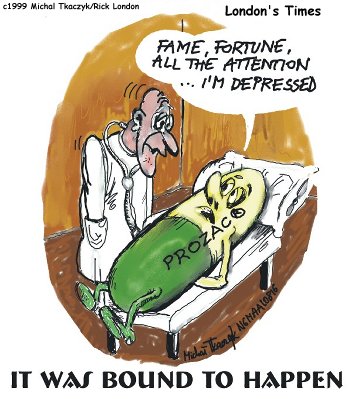
Prozac, used by 40m people, does not work say scientists

Prozac, used by 40m people, does not work say scientists

Analysis of unseen trials and other data concludes it is no better than placebo

Full text: the PLoS paper

Sarah Boseley, health editor
The Guardian,
Tuesday February 26 2008


A single Prozac capsule. Photograph: Alamy

Prozac, the bestselling antidepressant taken by 40 million people worldwide, does not work and nor do similar drugs in the same class, according to a major review released today.

The study examined all available data on the drugs, including results from clinical trials that the manufacturers chose not to publish at the time. The trials compared the effect on patients taking the drugs with those given a placebo or sugar pill. ...

You may read the whole article at

http://www.guardian.co.uk/society/2008/feb/26/mentalhealth.medicalresearch


If a would-be drug dealer sells his customers what they think is ecstasy, but only gives them sugar pills will they still get high? And is such a "pusher" breaking the law?
Also, do you think that it is possible that other medications besides Prozac that are out in the market are ineffective? If so, please feel free to discuss your thought on the subject.

Sunday, March 16

Prostitution


DO AS HE SAID

By NICHOLAS D. KRISTOF

March 13, 2008

New York Times


The last time I saw Eliot Spitzer, he encouraged me to write about his work involving prostitution. So here goes.

The governor buttonholed me because he wanted credit for passage of a tough state law against sex trafficking. Frankly, he deserves credit, for the law took the innovative step of cracking down on johns by increasing penalties.

The big worry now among those working to stop trafficking is that the Spitzer scandal will add to perceptions of prostitution as a “victimless crime.” On my blog, www.nytimes.com/ontheground, one person named “Carmen” argued, “if a man can hire a pro to help improve his golf, why not let him hire a pro to help improve his sex?”

Another poster, who identified herself as a former prostitute in Australia, said she had “never felt exploited or trapped” and added, “It was one of the best jobs I’ve ever had.”

Yet the evidence is overwhelming that, in the United States, prostitution is only very rarely just another career choice. Studies suggest that up to two-thirds of prostitutes have been sexually abused as girls, a majority have drug dependencies or mental illnesses, one-third have been threatened with death by pimps, and almost half have attempted suicide.

Melissa Farley, a psychologist who has written extensively about the subject, says that girls typically become prostitutes at age 13 or 14. She conducted a study finding that 89 percent of prostitutes urgently wanted to escape the work, and that two-thirds have post-traumatic stress disorder — not a problem for even the most frustrated burger-flipper.

The mortality data for prostitutes is staggering. The American Journal of Epidemiology published a meticulous study finding that the “workplace homicide rate for prostitutes” is 51 times that of the next most dangerous occupation for women, working in a liquor store. The average age of death of the prostitutes in the study was 34.


......
You may read the whole article at
http://www.nytimes.com/2008/03/13/opinion/13kristof.html?hp

Which approach (if any) do you agree with the most?

Sunday, March 9

Homeschool vs. Public Education

The advantages of home schooling versus public education have been debated for ages and have been a great cause of concern among parents. Parents keen on ascertaining a bright future for their children should dwell on the details of both home schooling and public education, scrutinize them thoroughly, before opting for any one of the two.


The Advantages Of Home Schooling


* The crucial advantage of home schooling is its flexibility. You can select the lessons to perfectly complement your child’s learning aptitude.

...
You may read the whole article at http://www.homeschoolinkwell.com/home-schooling-versus-public-education.html

Which method of education do you think is best and why?

Sunday, March 2

Freedom of Ignorance

FREEDOM OF IGNORANCE
Steven Derocher, February 27, 2008

Tolerance seems to be losing its popularity. We see evidence of this in the acts of violence and hate toward religious institutions across the world. However, some still espouse this vanishing virtue. One such individual is Krister Stendahl. He is the dean of Harvard Divinity School. He also spent a few years as the Lutheran bishop of Stockholm. In a meeting with the press in Sweden, Stendahl outlined three principles that he thought should govern our discussions of the religious beliefs of other people:

“(1) If you want to know what others believe, ask them. Don't ask their critics or their enemies. (2) When looking at the religious faith of others, compare your best with their best, not their worst with your best. (3) Always leave room for ‘holy envy.’"

Krister Stendahl is not of my religion. In fact, Lutherans have a great many differences with my faith. However, he encourages understanding and open-mindedness. This non-judgmental attitude has helped me appreciate Lutherans’ beliefs, as well as the beliefs of others. When I want to know what Lutherans believe, I will ask a Lutheran. When I want to know what Jews believe, I will ask a Jew. If I want to know what a skeptic believes, I will ask a skeptic. And upon comparing doctrine, as Stendahl suggests, I will compare bests with bests. This leads to “holy envy,” or, in other words, sincere appreciation of another’s convictions.

François Voltaire taught, “Love truth, but pardon error.” I can appreciate this conviction, and it appears to be illustrative of Voltaire’s “best.” In my consideration of his life’s work, I choose ignore the fact that he was a known skeptic, often leaving little room for “holy envy.” He once said, “Christianity is the most ridiculous, the most absurd, and bloody religion that has ever infected the world.” This is an obviously unfair statement. His biased, narrow-minded conclusion borders on absurdity. In this instance, Voltaire’s observation certainly could have been more generous.

According to a survey conducted by the Council on American-Islamic Relations (CAIR), 10 percent of Americans said they believe Muslims worship a moon god. CAIR also reported nearly 2,000 complaints of harassment, violence and discriminatory treatment in 2005, which was a 30 percent increase from incidents reported in the U.S. in 2004. This, says CAIR spokesman Ibrahim Hooper, is largely due to a “negative and politically charged environment on the Internet and talk radio.” Keep in mind these statistics can only be gathered from the discriminatory acts that are reported. (http://www.washingtonpost.com/wp-dyn/content/article/2006/09/18/AR2006091800597.html)

Again, I am not Muslim. And again, their doctrine varies from that of my own religion. But I don’t have to be Muslim or even a member of CAIR to see the connection between false propaganda and discrimination.* I cannot understand how anyone would feel justified in believing things about a group they didn’t hear from one of its members. By this same gullible logic I would rather take my Suzuki to a Ford dealership for difficult repairs than I would to the Suzuki dealership. Perpetuating the intolerant ignorance would be just the same as then referring everyone else to the Ford dealership, trash talking the Suzuki dealership in the process.

I fear that too often we would rather agree with those most like us than think for ourselves. Such “mob mentality” is hardly ever founded on reality. When people look to popular opinion for accuracy, trustworthiness is weakened. James A. Haught wrote an essay entitled “Breaking the Last Taboo” over eleven years ago. He begins by citing numerous well-known writers and philosophers. All of the quotations are anti-religion in nature. It almost seems that he takes an innocent, neutral stand, as if to say, “Here is the evidence. I’m just giving you the impartial facts from society’s greatest minds.” As if this wasn’t enough to prove ignorant prejudice, he goes on to contrast these noble opinions with “Christianity’s” worst and darkest deeds. What a perfect example of “comparing bests with worsts!”
There is nothing to be gained from intolerance. Those who feel the need to circulate their opinions about the world should seek thorough understanding.


http://www.youtube.com/watch?v=uum0FUMdejE


Please watch the following before commenting on this article:

Sunday, February 24

Both sides on gay adoption cite concern for children


By Andrea Stone, USA TODAY


When Harold Birtcher and his partner, Thom O'Reilly, decided to adopt a child three years ago, Ohio officials told the men only one of them could become the legal parent. In Ohio, same-sex partners are barred from joint adoption.


So the men, who have been together for 25 years, went to Oregon to jointly adopt Michael, now 10. The boy had been beaten and sexually abused, O'Reilly says, and refused to hug anyone for most of his four years in foster care.
....


You may read the whole article at
http://usatoday.printthis.clickability.com/pt/cpt?action=cpt&title=USATODAY.com+-+Both+sides+on+gay+adoption+cite+concern+for+children&expire=&urlID=17284478&fb=Y&url=http%3A%2F%2Fwww.usatoday.com%2Fnews%2Fnation%2F2006-02-20-gay-adoption-foster_x.ht
Do you support or oppose gay adoption?

Sunday, February 17

The immigrants they scorn


Feb. 13, 2008 12:00 AM

While some presidential candidates try to score political points by playing into apprehension about immigration, the immigrants they vilify are busy sustaining the American economy.Immigrants play a crucial role in our nation's academic, medical and high-tech sectors.
.......


You may read the whole article at
http://www.azcentral.com/arizonarepublic/opinions/articles/0213pastor13.html
Should illegal immigrants be given an amnesty or should they be deported?

Link: http://www.azcentral.com/arizonarepublic/opinions/articles/0213pastor13.html

Thursday, February 7

Abortion rates same whether legal or not


Abortion rates same whether legal or not


Study: Rich, poor countries have equal statistics; half of procedures unsafe


LONDON - Women are just as likely to get an abortion in countries where it is outlawed as they are in countries where it is legal, according to research published Friday.
In a study examining abortion trends from 1995 to 2003, experts also found that abortion rates are virtually equal in rich and poor countries, and that half of all abortions worldwide are unsafe.
....
You may read the whole article at http://www.msnbc.msn.com/id/21255186/


Are you pro-life or pro-choice and why?

Sunday, February 3

The Fight For the Right to Die


Last Updated June 11, 2007
CBC News
Sue Rodriguez fought the law prohibiting assisted suicide all the way to the Supreme Court of Canada, but lost. (CP Photo) In 1992, Sue Rodriguez forced the right-to-die debate into the spotlight in Canada. In a video statement played to members of Parliament, the Victoria woman, diagnosed with Lou Gehrig's disease in 1991, asked lawmakers to change the law banning assisted suicide.
...
You may read the whole article at http://www.cbc.ca/news/background/assistedsuicide/


"Do you support legislation that legalizes assisted suicide or do you oppose it?"

Monday, January 28

Tampa Officer, Teen Helper Attacked During Investigation


Tampa Officer, Teen Helper Attacked During Investigation


By THOMAS W. KRAUSE and CLAUDIA DoCAMPO, The Tampa Tribune News Channel 8 Published: December 26, 2007


TAMPA - A Tampa police officer and a teenage member of the police Explorer program were attacked while investigating a possible burglary Monday night. Both were hit over the head with a police baton during a struggle outside a vacant house at 312 Floribraska Ave., according to police reports. Fernando Lopez, who lives next door to the vacant house, said he was cooking a holiday meal with his mother when he saw a young man and woman bend back some bars on the house and crawl in through a window. "I knocked on the window and said, 'Get out of there; I'm going to call the police,'" Lopez said Tuesday. .....
You may read the whole article at

Monday, January 21

"Guarding Deaths Door"


On March 20, a man named Keith Clay died in Texas. His death was largely unremarkable except for one thing: he was the 300th person executed in Texas since the U.S. Supreme Court reauthorized capital punishment in 1976. One need not ignore the savagery of his crimes--prosecutors said Clay stood by while a friend murdered a father and his two kids on Christmas Eve 1993, 11 days before Clay himself butchered a store clerk--to pause at his execution. Three hundred is an impressive milestone, not only because it exceeds the number of executions in the next five top death-penalty states combined, but also because it was reached so quickly. It took nearly two decades for Texas to consummate its first 100 death sentences after 1976--but only five more years to pass 200 and just three after that to hit 300. (The total has since climbed to 306.)
.....


You may read the rest of this article at http://www.time.com/time/magazine/article/0,9171,1005201,00.html.


What do you think of the death penalty?

Saturday, January 12

Intelligent Design vs. Evolution


Wednesday, Aug. 03, 2005
Fanning the Controversy Over 'Intelligent Design'
By Matthew Cooper/Washington


A light-hearted White House conversation with representatives of Texas newspapers may have opened a new controversy for President George W. Bush. The President laughed when Knight-Ridder�s Ron Hutcheson asked for Mr. Bush�s "personal views" about the theory of "intelligent design", which religious activists advocate should be taught in U.S. schools as an alternative to theories of evolution. After joking that the reporter was "doing a fine job of dragging me back to the past," to his days as governor of Texas, Bush said: "Then, I said that, first of all, that decision should be made to local school districts, but I felt like both sides ought to be properly taught...�
....
You may read the whole article at
http://www.time.com/time/printout/0,8816,1089733,00.html


Do you think Intelligent Design should be taught in our schools?

Tuesday, December 11

Have a great Christmas and a terrific new year!


We'll be back mid January.


:)) A MUST READ ON THE BENEFITS OF CULTURAL RELATIVISM: Seeing the World from Iran's Point of View


:(( Judge Sarah Bradley decided not to jail nine men guilty of gang raping a 10-year-old girl in an Aboriginal community. In her ruling she told the rapists that the 10-year old "probably agreed to have sex with all of you".


Sunday, November 25

Legal or Not, Abortion Rates Compare

New York Times
By ELISABETH ROSENTHAL
Published: October 12, 2007

ROME, Oct. 11 — A comprehensive global study of abortion has concluded that abortion rates are similar in countries where it is legal and those where it is not, suggesting that outlawing the procedure does little to deter women seeking it.
Moreover, the researchers found that abortion was safe in countries where it was legal, but dangerous in countries where it was outlawed and performed clandestinely. Globally, abortion accounts for 13 percent of women’s deaths during pregnancy and childbirth, and there are 31 abortions for every 100 live births, the study said.
Read full article


Here in the U.S. laws have never stopped abortion, but only relegated it to back- alley butchers. Abortion was criminalized throughout the U.S. between the late 1800s and 1973.

In 1973 the our Supreme Court handed down Roe v. Wade legalizing abortion in all 50 states.

Laws have never stopped abortion, but only relegated it to back-alley butchers. Abortion was criminalized throughout the U.S. between the late 1800s and 1973. But during that time, millions of women sought and obtained abortions anyway. Illegal abortions were commonly performed in unsafe conditions, and maternal complications and death were common.


There are two sides to the issue here in the U.S.


Pro-Choice, which takes a legal stance that is is the right of a woman to make her own choice on this matter.
Pro-life, which takes a moral stance that it should be illegal based on personal religious beliefs.


What are your views on this highly debated emotional issue?

Sunday, November 18

Illegal Immigration


The Immigration and Naturalization Service (INS) estimates that in January of 2000 there were7 million illegal aliens living in the United States, a number that is growing by half a million a year. Thus, the illegal-alien population in 2003 stands at at least 8 million. Included in this estimate are approximately 78,000 illegal aliens from countries who are of special concern in the war on terror. It is important to note that the 500,000 annual increase is the net growth in the illegal-alien population (new illegal immigration minus deaths, legalizations, and out-migration).
You may read the whole article at
What are your thoughts on illegal immigrants?

Sunday, November 11

America’s Lagging Health Care System


Editorial in New York Times about this survey taken


America’s Lagging Health Care System

Published: November 1, 2007
Americans are increasingly frustrated about the sub par performance of this country’s fragmented health care system, and with good reason. A new survey of patients in seven industrialized nations underscores just how badly sick Americans fare compared with patients in other nations. One-third of the American respondents felt their system is so dysfunctional that it needs to be rebuilt completely — the highest rate in any country surveyed. The system was given poor scores both by low-income, uninsured patients and by many higher-income patients.


Do you agree or disagree that America should go to a more universal heath careprogram?

Sunday, November 4

Thousands Rally Against Iraq War In S.F.

Thousands Rally Against Iraq War In S.F.
POSTED: 4:42 pm PDT October 27, 2007
UPDATED: 6:36 pm PDT October 27, 2007

SAN FRANCISCO -- Thousands of people called for a swift end to the war in Iraq as they marched through downtown on Saturday, chanting and carrying signs that read: "Wall Street Gets Rich, Iraqis and GIs Die" or "Drop Tuition Not Bombs."
...
You may read the whole article at http://www.ktvu.com/news/14439605/detail.html

What do you think about the war?

Sunday, October 28

Mixed Grades In a New Education Report


Mixed Grades in a New Education Report


The education secretary says stats show No Child Left Behind is working.
By Peg Tyre
Newsweek Web Exclusive
Updated: 3:54 PM ET Sep 27, 2007


The 2007 National Assessment of Education Progress, known as the Nation's Report Card, was released today for reading and math in fourth and eighth grade—and what it tells us about our children's abilities in mathematics and reading is bound to add fuel to the already contentious debate about No Child Left Behind.
...
You may read the whole article at http://www.newsweek.com/id/41312/output/print

What kind of changes does the high school you graduated from need to implement?

URL: http://www.newsweek.com/id/41312
© 2007 Newsweek.com

Saturday, October 20

Stop the failed war on drugs: By Bill Steigerwald


October 16, 2007


Let's hear it for America's drug police.

Last year our drug warriors made 829,627 marijuana arrests.

That's the most ever, according to the FBI. Arrests for marijuana -- arguably the least dangerous drug ever declared illegal in America -- are up nearly threefold since 1990. Total arrests for all illegal drugs in 2006 hit 1.89 million, up from 1.08 million in 1990.


...


What do you think? Do you agree with with the author or not?

Sunday, October 14

Gay parents


Gay adoption: A new take on the American family
By Taylor Gandossy
June 27, 2007
CNN


ATLANTA, Georgia (CNN) -- For 5-year-old Jackson Manford-Roach, Mother's Day means it's time to see his grandmothers.

"I don't need little lace gloves, which is what [Jackson and his classmates] made this year," Jeffrey Roach, one of Jackson's two fathers, said. "The other kids always ask who he's making the stuff for and he always makes his for his grandma."

....

Read the whole article at http://www.cnn.com/2007/US/06/25/gay.adoption/index.html


What do you think?

Sunday, October 7

A Different War on Drugs


A Promising New HPV Vaccine Gets Caught Up In The Culture War
BY MATTHEW VALJI
January 17, 2007

Twenty million Americans are currently infected with the Human Papillomavirus, more commonly known as HPV. According to the Center for Disease Control, a shocking 75 percent of Americans ages 15 to 49 have acquired HPV at some point in their lives. For most, this STI will clear up quickly on its own with little or no permanent aftereffects, but for about one percent of women infected, it results in cervical cancer.

....

Read the whole article at http://hprsite.squarespace.com/different-war-on-drugs-012007/


Should this vaccine be required just as other vaccines are required for school children of a certain age or should it be left up to the parents?